
AI Software Development: What AI Does at Each SDLC Stage
Related guide: Developer productivity metrics for AI-assisted teams
AI software development means using AI models and coding agents at every stage of building software: planning, coding, testing, review, deployment and maintenance. Agents draft and run the work; engineers set the task, check the result and own what ships.
Zest records each engineer's coding-agent sessions, with model, tokens and skills, and links each one to the GitHub pull request it led to. Start freeGet started
Most developers now work this way: in Stack Overflow’s 2026 survey, coding assistants and agents were the most common use of AI, named by 66% of respondents.
What AI does at each stage of software development
An agent is strongest where it can check its result by running something, and weakest where the question is what to build.
| Stage | What AI does | What the engineer keeps | What to watch |
|---|---|---|---|
| Planning | Reads the ticket and the repository, lists the files involved, drafts a plan and open questions | What to build and what “done” means | A tidy plan built on a wrong assumption |
| Design | Proposes options, interfaces and diagrams | The trade-offs: cost, risk, what must never break | Designs that ignore constraints nobody told it |
| Coding | Edits across files, runs commands, fixes its own build errors | The scope, and the decision to merge | Big diffs, the hardest kind to review |
| Testing | Writes and runs tests, reproduces a bug from a failing case | What has to be tested | Tests that pass without checking anything |
| Code review | Gives every pull request a first pass for bugs, missing tests and security issues | Approval, and whether this is the right change | Findings an agent dismisses without fixing |
| Deployment | Drafts and debugs CI/CD configuration, reads failed runs | Release timing, rollbacks, production access | Agents holding production credentials |
| Maintenance | Upgrades dependencies, refactors, updates docs, fixes bugs from logs | Priorities, and how much churn to accept | Duplicated code nobody asked for |
The coding and testing rows moved furthest, because an agent can run the loop of edit, test and fix by itself. AI coding agents explains how that loop works and how teams run it.
How much of software development does AI do today?
AI’s share of software development depends on what you count. Three recent numbers, read on November 11, 2026:
- People using it: 90% of software development professionals in Google’s 2025 DORA survey of nearly 5,000 had adopted AI, working with it a median of two hours a day (Google).
- Daily use: in Stack Overflow’s 2026 survey, 73% of respondents use coding assistants and agents daily, and 31% of daily AI users spend more than four hours a day with it (Stack Overflow).
- Code written: 75% of new code at Google is AI-generated and approved by engineers, up from 50% the previous fall (Sundar Pichai, April 2026). That is new code at one company with its own tools, not software in general.
Trust lags use. In the Stack Overflow survey, 48% trust AI when they can easily validate the answer, and 16% extend that trust to most tasks that aren’t important work decisions. In DORA’s survey, 30% reported little or no trust in AI-generated code.
Does AI make software development faster?
Most developers say AI makes them faster, but the evidence is weaker than the headlines, and what people report differs from what trials measure.
- What people report: over 80% of DORA’s 2025 respondents said AI raised their productivity, and 59% said it helped code quality.
- What trials measured: in METR’s randomized trial of experienced open-source developers in early 2025, tasks took 19% longer with AI allowed (confidence interval +2% to +39%). Its follow-up estimated 18% less time for returning developers (−38% to +9%) and 4% less for new recruits (−15% to +9%), and METR itself calls that data “an unreliable signal”, likely understating the speedup because the developers who gain most won’t work without AI (METR, February 2026). Quote neither number as today’s effect.
- What happens to delivery: DORA found AI adoption linked to higher delivery throughput and, still, to lower delivery stability, and warns that without strong automated testing, version control and fast feedback, more change leads to instability (Google Cloud). Its summary is that AI is an amplifier of an organization’s existing strengths and weaknesses.
Someone else’s average won’t tell you what AI does on your codebase. You have to measure your own.
What our own agent-written pull requests show
Our own numbers give a narrower view: one small team, two repositories, agents doing most of the coding. We studied 866 agent-written pull requests merged from August 12 to October 4, 2026, and the reviews of pull requests merged in those weeks. Three results stood out:
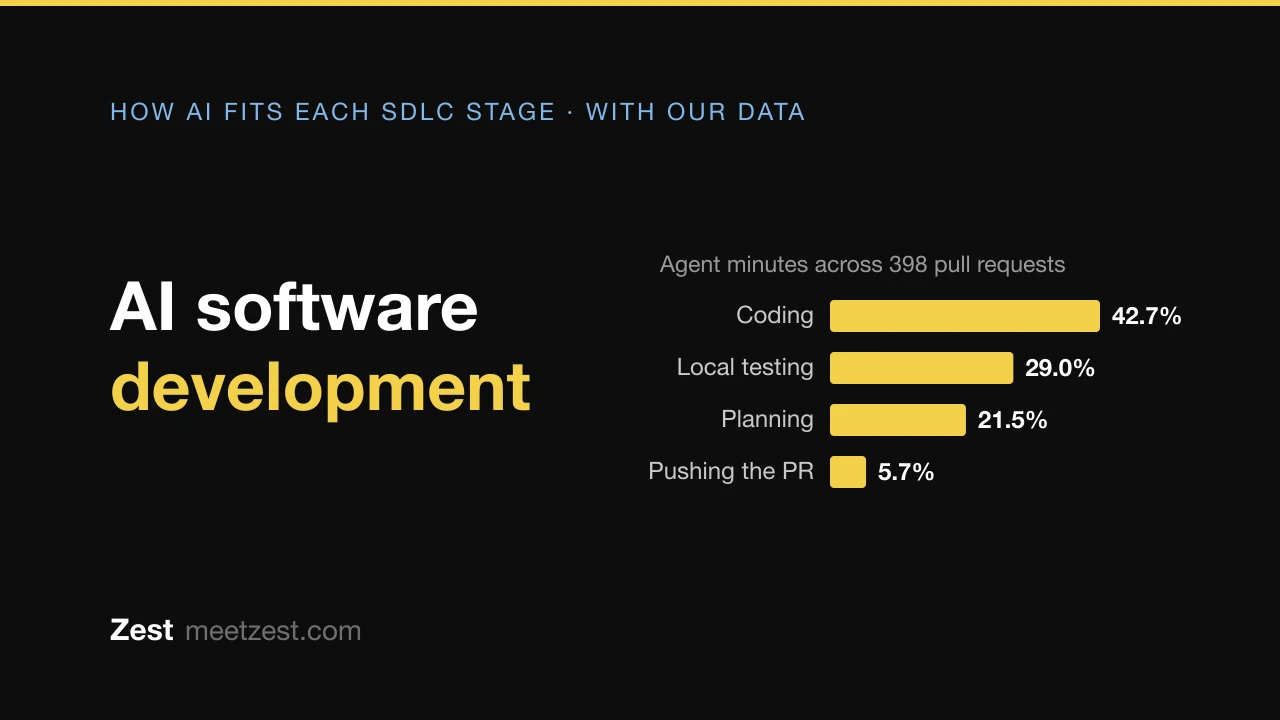
- Coding is under half of an agent’s session. Across the 398 of those 866 that report minutes, 42.7% went to coding, 29.0% to local testing and 21.5% to planning, by the agents’ own estimates. Planning and testing burn tokens too, so budget for them.
- Pull request size predicts trouble better than the model does. Our AI reviewer flagged 11% of pull requests under 100 lines with a should-fix issue, and 57% of those between 1,000 and 3,000 lines, across all 1,232 reviewed pull requests with a readable first pass. The gap between models mostly disappeared once we compared the same engineer, repository and week.
- The first draft is rarely the last. In the 30 days to October 4, 58% of reviewed pull requests got at least one fix round from the coding agent.
The reviewer is IonWarp, our sister product, and one team’s habits are not an industry sample.
What are the best AI tools for software development?
The AI tools for software development most developers use are four coding agents. Of the 12,255 developers who answered Stack Overflow’s 2026 question on coding agents, 66% had used Claude Code in the past year, 59% GitHub Copilot, 30% OpenAI Codex and 26% Cursor (Stack Overflow). A working setup usually has three layers:
- A coding agent writes and tests the change. Claude Code vs Codex vs Cursor compares three of them, including what each costs per engineer, and the best model for coding covers the model underneath.
- A review step reads every pull request before a person does. Code review practices covers what a person should still check.
- Usage and cost reporting shows who uses what and what ships, covered below.
For a wider list, see the best AI coding tools.
What are the risks of AI in software development?
The main risks of AI in software development are insecure code, more change than review can absorb, lost skills, and data or licensing surprises.
- Insecure code. In Veracode’s October 2026 tests of 18 models, about 38% of AI code generation tasks still produced code with a known vulnerability, down from about 44% in July, while the syntax was correct nearly 100% of the time (Veracode, October 2026). Veracode sells code scanning, so weigh that, but code that compiles can still be unsafe. Run a security scanner in CI.
- More change than review can absorb. Agents write faster than people read. Keep pull requests small and let an automated reviewer take the first pass, so people spend their attention on the design. What slips through becomes technical debt.
- Lost skills. In Stack Overflow’s survey, concern over losing job skills or training an AI to replace you is the top reason people give for avoiding AI at work or school (17%). Ask the author of a change to explain it in review, whoever or whatever typed it.
- Data and licensing. GitHub lists intellectual property among the risks of AI-written code (GitHub). Check your plan’s data terms before sending private code to a model, and have legal read the terms for generated code.
How to start using AI in software development
Starting takes more process than tooling. In the order we would do it:
- Write a project instructions file.
CLAUDE.mdfor Claude Code,AGENTS.mdfor Codex and several others: build and test commands, code style, and what the agent must never touch. - Give the agent one fast test command. It checks its own work by running your tests.
- Start with tasks you can check. A bug with a failing test, a dependency upgrade, missing test coverage.
- Keep pull requests small. See the review numbers above.
- Keep a person on every merge, with a security scan in CI.
- Record what each session used from the first week. The model behind most of our pull requests changed twice in four weeks, so a per-model number goes stale fast unless each session stores it.
How to measure AI software development on a team
Measuring AI software development takes two views: usage and outcomes. Each agent’s own dashboard shows usage: Claude Code, Codex, Cursor and GitHub Copilot. Delivery outcomes come from your CI/CD and incident tools as DORA metrics. Developer productivity metrics covers which to pick, and software engineering intelligence platforms join those sources for you. AI coding analytics tools compares the agents’ own dashboards with those platforms, prices included.
Zest is ours and narrower. A plugin or extension in each engineer’s coding agent records every session’s model, tokens, skills and MCP tools, and Zest links the session to the GitHub pull request it led to. It computes no DORA metrics, runs no surveys and connects to no code host but GitHub, so keep your other tools for those.
Frequently asked questions
Will AI replace software developers?
Not on current evidence. Even at Google, where AI now generates most new code, engineers approve it. The work shifts toward setting the task and owning the result. Nobody has good data yet on what that does to team sizes over time.
What does AI SDLC mean?
AI SDLC means using AI at each stage of the software development lifecycle, not only for writing code: planning, design, testing, review, deployment and maintenance too. The engineer keeps what to build, the scope and the decision to merge.
How do you develop AI software?
Developing AI software, meaning a product with a model inside it, is a different job from using AI to write code. You choose a model, test its output against examples you trust because the same input can give different answers, then watch cost and quality in production. AI software engineering has a section on integrating models and the skills that takes.
Can you build software with AI without knowing how to code?
For small personal tools, yes: that is usually called vibe coding. Anything that handles other people’s data or money still needs someone who can read the code: in Veracode’s October 2026 tests, roughly 4 in 10 AI code generation tasks produced code with a known vulnerability.
Zest is AI coding analytics for engineering teams: it shows which coding agents, models and skills each engineer uses, what they cost, and which sessions end in merged pull requests. See how Zest works.